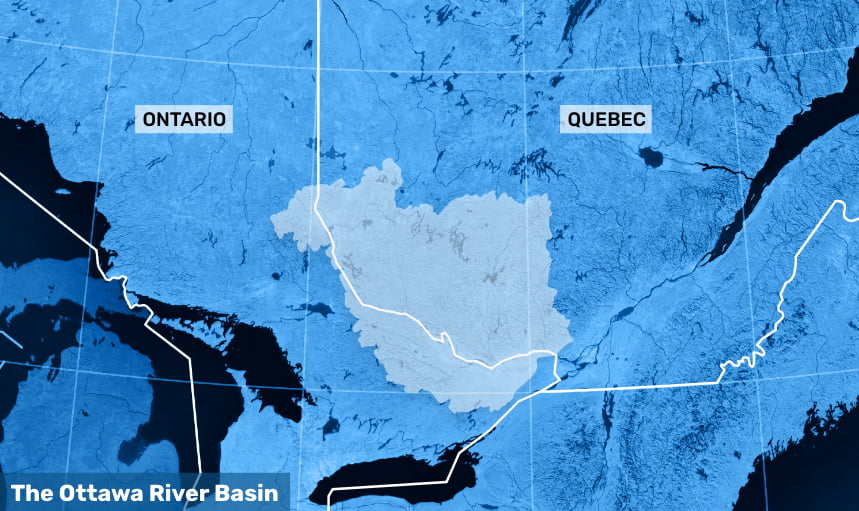
The Planning Board was established to ensure integrated management of the principal reservoirs of the Ottawa River basin:
To learn more about the Planning Board, see the presentation : Flow Management in the Ottawa River Basin – 2026
Water levels and flows continue to rise at all locations along the main stem of the Ottawa River as significant runoff from rainfall and snowmelt from the unregulated portion of the basin flow into the river. Reservoirs are retaining spring runoff to reduce flooding in the dowstream river system. Minor flood levels have been exceeded in most flood prone areas along the Ottawa River from Pembroke down to Carillon. Major flood levels from Lake Coulonge to Carillon may be exceeded over the next few days depending on weather. The minor and major flood levels are defined on the Home page in the Special Feature section. Levels should continue increasing over the next few days in all locations and start stabilizing on Monday. Our website Forecasts section provides expected water levels over a four-day horizon in several areas. Uncertain weather factors play into estimating peak levels over the coming week. On April 18 peak level estimates are generally above 2025 peak levels but below 2023 peak levels, as follows: Pembroke (113.05 m), Lac Coulonge (108.55 m), Chats Lake (75.55 m), Lake Deschenes (60.2 m), Gatineau -Hull marina (44.45 m) and Thurso (42.95 m). These exceed 2025 peak levels by 20 cm (Pembroke), 40 cm (Lake Coulonge), 30 cm (Chats Lake), 45 cm (Lake Deschenes/Britannia), 90 cm (Gatineau -Hull marina) and 65 cm (Thurso). Over the next two weeks, levels are expected to plateau or slowly decline depending on weather. Risk of further increase in levels over coming weeks is higher from Mattawa to Lake Coulonge given the high snowpack remaining in the northern part of the basin.
See the “River Conditions Forecasts” message for the latest update on river conditions and details as to what locations may experience flooding over the next few days.
In River Conditions Forecast messages:
Read the press release >> April 13, 2026 Press Release
**** Technical note: Due to higher‑than‑normal traffic on the website—especially during the spring flood period—you may experience slower performance or see water levels and flows that are not up to date. If this happens, try clearing your browser cache, refreshing the page, or switching to the French version of the page. ***
Our website provides a map that will help you keep track of the snow cover in the watershed. The map of the snow water equivalent is available on the Current Conditions webpage (click on the “Snow Map” button at the top of the interactive map).
Snow measurements are done on a regular basis at over one hundred (100) sites across the basin. The snow map provides an overview of conditions at the time of the most recent snow measurements. It shows the amount of water held in the snow cover compared to the amount of water it normally holds at this same time of year. This amount of water is called ‘snow water equivalent’. The map covers the entire Ottawa River watershed. At a glance, it is possible to see if there was more or less snow than usual at a given time of the year.
Understanding snow water equivalent is important as it is one of the factors that contribute to shaping the magnitude and duration of a spring freshet. For more information on factors that influence a spring freshet, please see FAQ 1: FAQs – Ottawa River Regulation Planning Board
This map will be updated in early March, and every two weeks thereafter.
Press Release posted on 2026-04-13 by Ottawa River Regulating Committee
The Ottawa River Regulating Committee warns that water levels and flows along the main stem of the Ottawa River are
Bulletins posted on 2026-04-02 by Ottawa River Regulation Secretariat
The detailed four-day forecast has now begun. The Ottawa River Regulating Committee provides hydrological forecasts to the public at nine
Press Release posted on 2026-04-02 by Ottawa River Regulating Committee
The Ottawa River Regulating Committee would like to inform basin residents that levels and flows along the Ottawa River are